
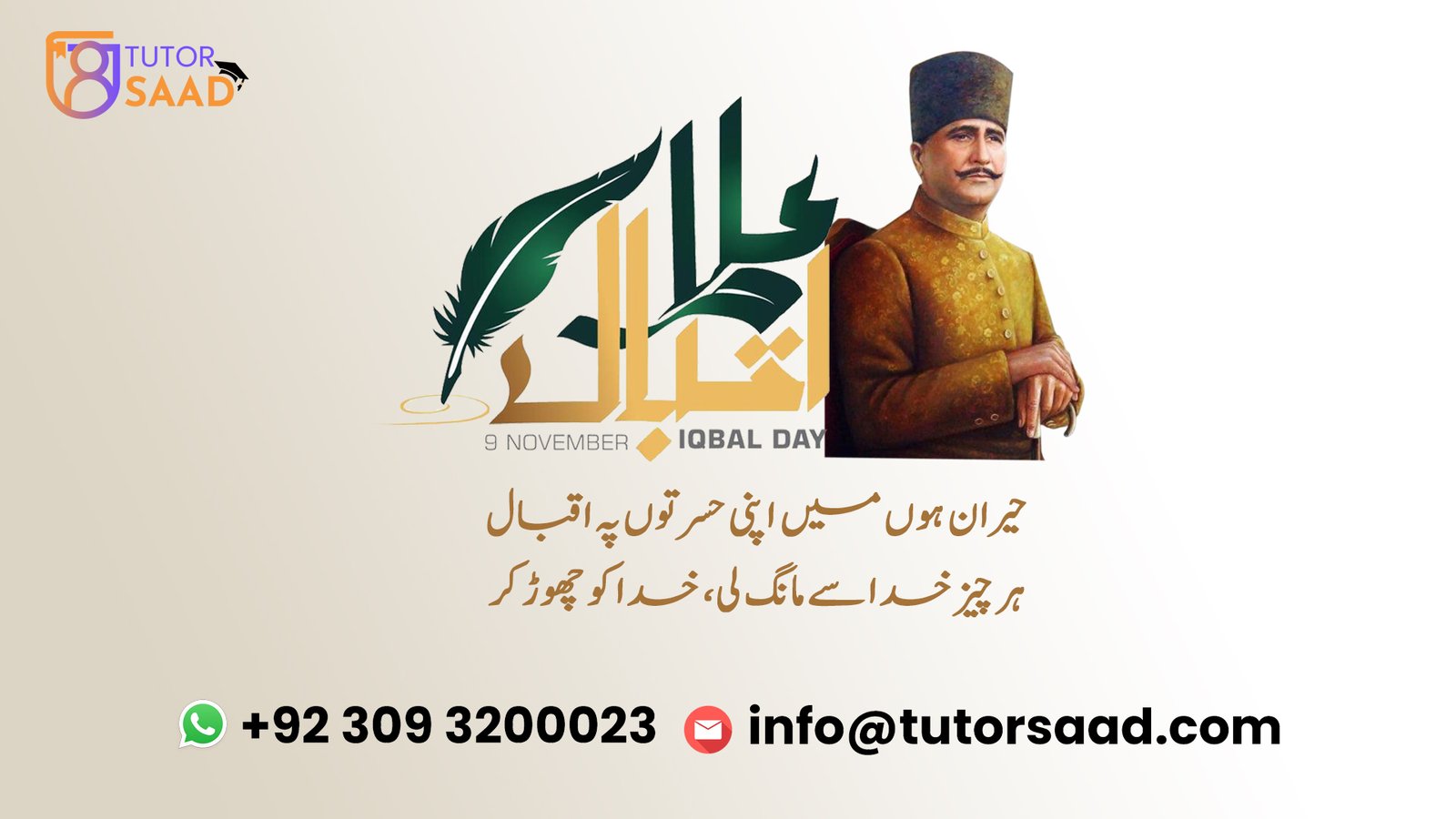
Birth and Religion:
Mohammad Iqbal (1877-1938), a descendant of a Kashmiri Brahmin family that had embraced Islam in the seventeenth century, was born and settled in Sialkot. After a traditional education in Arabic, Persian, and Urdu, he was exposed to a liberal education that defined the contours of his thought and his poetry during the entire period of his life. He wrote the famous patriotic song that celebrates the greatness of India. King George V decorated him with knighthood and he was called Sir Mohammad Iqbal thereafter.
Allama Mohammad Iqbal is rightly considered the poet of the East. He influenced the thought, the history and the lives of the people of the Sub-continent to a great extent. With his powerful poetry, written in the classical style for public recitation, Iqbal introduced the concept of ‘Khudi’ and led Muslims to rethink their standing in the world. He was deep in the realms of spiritual thought drawing great inspiration from Jalal-uddin Rumi.
Education:
For higher education Iqbal went to Lahore (1895), where he enrolled in Government College, getting, in 1899, an MA in philosophy; he had already obtained a degree in law (1898). In Lahore, a major center of academic and literary activity, Iqbal soon made a name for himself as a poet. One of the teachers of Government College Iqbal admired most was Sir Thomas Arnold. Arnold, too, had great affection for Iqbal, he helped Iqbal in his career as a teacher and also encouraged him to undertake several research projects. When Arnold returned to England in 1904, Iqbal wrote a touching poem in which he expressed his resolve to follow Arnold to England. The very next year, in fact, Iqbal left for study at Cambridge. His choice of Cambridge was probably dictated by the fact that Cambridge was reputed for the study not only of European philosophy but also of Arabic and Persian. In his three years of stay abroad, Iqbal obtained a BA from Cambridge (1906), qualified as a barrister at London’s Middle Temple (1906), and earned a PhD from Munich University (1908).
After returning to Lahore in 1908, Iqbal taught philosophy at Government College for a few years. In 1911 he resigned from government service and set up legal practice.
Interest in poetry:
Allama Iqbal wrote many poetries in Urdu and Persian, Asrar-i Khudi (Persian) was published in 1915. Translated into English as The Secrets of the Self (1920) by Professor Reynold Nicholson of Cambridge, the book introduced Iqbal to the West. Asrar-i Khudi was followed by several other volumes: Rumuz-i Bikhudi (1918), Payam-i Mashriq (1923), Bang-i Dara (1924), Zabur-i ‘Ajam (1927), Javid Namah (1932), Musafir (1936), Zarb-i Kalim (1937), and Armaghan-i Hijaz (1938, posthumously). Iqbal wrote prose also. His doctoral thesis, The Development of Metaphysics in Persia, was published in 1908, and his Reconstruction of Religious Thought in Islam (with a 7th chapter added to the original set of six lectures, first published in 1930), in 1934.

Iqbal had a fine sense of the dramatic, and in his poetry he frequently employs dramatic techniques. Many of his poems are structured like a play, with the first half of the poem building a tension or conflict that is resolved, or raising a question that is answered, in the second half Examples are “Gabriel and Iblis”, “The Dew and the Stars”, “The Houri and the Poet” and “Fatimah bint ‘Abdullah”. Many poems are dialogues, with well-argued positions taken by the interlocutors (“A Dialogue Between God and Man”, “The Dew and the Stars”, “Reason and Heart” and “A Dialogue Between Knowledge and Love”; also the fables). Some poems are one-sided dialogues or monologues (“Give Me Another Adversary”, “The Falcon’s Advice to Its Youngster”). Again, Iqbal carefully weaves the “plot” of a poem, arousing the reader’s curiosity, dropping seemingly casual hints that turn out to be prophetic, providing flashback, and saving his masterstroke for the end. Two excellent examples are “The Night and the Poet” and “The Houri and the Poet”.

Naturistic Person:
Iqbal loves nature and its processes. He likes the greenery and blooming flowers and beauty of Nautre. Iqbal has some favorite images and motifs. The eagle is Iqbal’s favorite bird, and the tulip his favorite flower. We will here say a few words about the tulip. The tulip is a pretty flower, but, when it grows in the desert (Lala’-i sahra’), it combines strength with beauty, for it then represents the assertion of one’s self (khudi) in the face of hostile circumstances. The tulip owes its splendor not to an outside source but to the “scar” inside its heart, its glow being indigenous to it, as befits a flower with a khudi of its own. The tulip is thus a “model” for individuals and nations to follow. In one of his quatrains (“Freedom and Determinism and Philosophy of History”), speaking of the difficult circumstances that alone give birth to new nations, Iqbal says: “From mountains and deserts do nations arise.” Although Iqbal does not mention the tulip in this quatrain, it would not be far-fetched to suggest that, conceptually, Iqbal here has the desert tulip in mind. The cup-shaped flower suggests to Iqbal’s mind several analogies, and in one piece (“Locke, Kant, and Bergson,”) Iqbal, makes consistent use of the tulip image to describe and analyze complex philosophical ideas. It is in view of the deep significance of the flower in Iqbal’s poetry that I have chosen Tulip in the Desert as the title of my volume of translations (Mustansir Mir, Tulip in the Desert, Hurst and Company, London, 2000). That’s why he is called as naturistic person.
Struggle in Polotics:
Allama Iqbal was a significant politician in British India who is credited with conceptualizing Pakistan as a separate homeland for Muslims. He started his political career in 1908 and served as the president of All India Muslim League.
Key political activities and positions
- Conceptualizing Pakistan: Iqbal’s most lasting political legacy is his role in developing the idea of a separate Muslim state in the subcontinent. His 1930 Allahabad Address articulated the need for Muslims to have self-governance and autonomy in a separate state.
- Advocating for Muslim rights: He was a prominent voice for the political and religious rights of Indian Muslims, advocating for them in speeches and within the political system.
- Leadership roles:
- He joined the Muslim League in 1908 and rose through the ranks to become one of its most influential leaders.
- He served as the president of the All India Muslim League.
- He was elected to the Punjab Legislative Council in 1926, where he advocated for Muslim interests and rights.
- Political philosophy:
- Initially, he believed in a composite Indian nationalism, but his views shifted after his trip to Europe in 1905–1908.
- He advocated for a political system based on Islamic ideology, believing that a strong political foundation was essential for the moral and spiritual growth of Muslims.
- He supported a cooperative relationship between religion and politics, arguing that religion separated from politics would become a source of tyranny.
- Shift in ideology: He moved away from his earlier support for a united India and began to advocate for a separate Muslim state as the solution to the political and economic plight of Indian Muslims. This shift is reflected in his change from the poem which celebrated a global Islamic community.
Last Decade of life:
Allama Iqbal had a busy period in Indian politics during September 1931- February 1932 because of popular acknowledgment by the masses as Muslim thinker and leader. The Kashmir cause persisted dear to him and never missed to highlight the cause which is evident from his poetry. Iqbal worked in his last phase of politics on two ends: primarily to transform the thinking approach of Muhammad Ali Jinnah towards the idea of Pakistan and later, to make the Muslim League the sole accredited voice of Muslims. Between May 1936 and June 1937, Iqbal extended his idea of a separate state via confidential letters to Jinnah and outlined what he envisaged for the best interest of Indian Muslims.
Sir Muhammad Iqbal, also known as Allama Iqbal was a philosopher, poet and politician in British India. He died on 21th April 1938. He is considered one of the most important figures in Urdu literature, with literary work in both Urdu and Persian languages.he was also called as Muslim philosophical thinker of modern times. Iqbal is known as Shair-e-Mushriq meaning Poet of the East. He is also called Muffakir-e-Pakistan (“The Inceptor of Pakistan”) and Hakeem-ul-Ummat (“The Sage of the Ummah”). In Iran and Afghanistan he is famous as Iqbāl-e Lāhorī or Iqbal of Lahore, and he is most appreciated for his Persian work. Pakistan Government had recognised him as its National Poet.He has different literary and narrative works