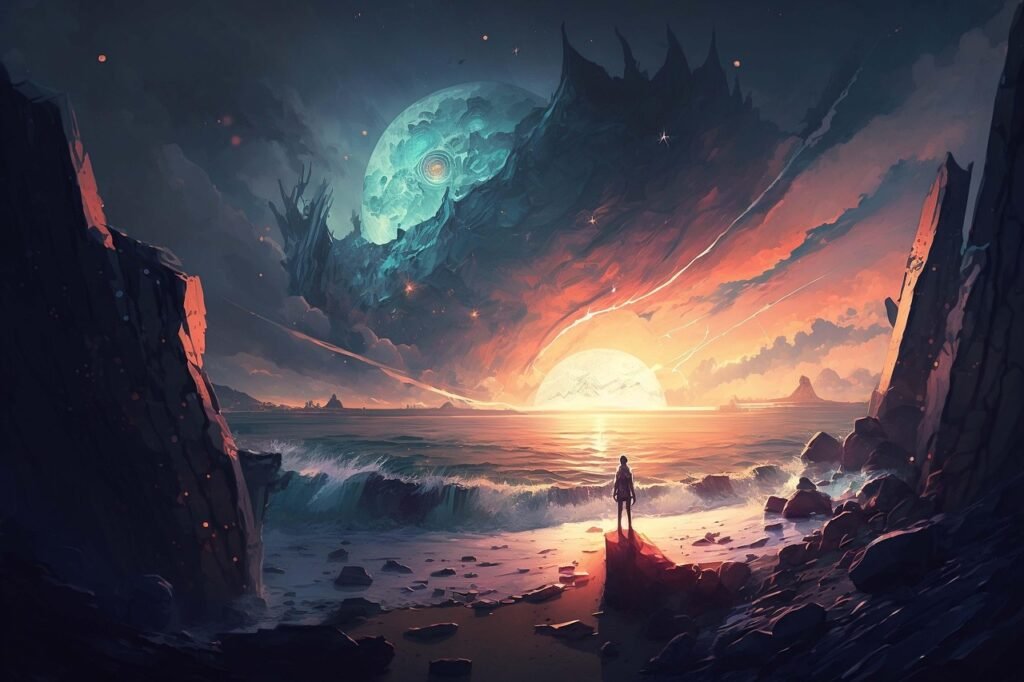
AI-generated images are among the most exciting applications of GenAI, a subset of machine learning that creates new content rather than merely analyzes existing information. These visuals are conjured up by deep learning models with complex architectures trained on large volumes of images—often millions or even billions of labeled ones scraped from the web or from sprawling licensed libraries
The Mechanics of Creation
In creating the images, the typical process begins with a text-to-image prompt: a natural language description that a user provides, for example, “A photorealistic cat wearing a spacesuit, sitting on the moon, in the style of a 1980s sci-fi movie poster”.
Text Understanding: This means that the AI first processes the given text prompt with NLP (natural language processing). The words and relationships are translated to a machine-friendly numerical representation, or embedding, capturing the semantic meaning and the visual attributes of interest.
Generative Models: The core of the process relies on powerful neural network architectures. Among those, the following two dominate:
Diffusion Models : It represent the current state of the art and function by taking an image of pure, random noise and iteratively “denoising” it over a series of steps. In such a case, guided by the embedding of the text prompt, the model refines the noise into a coherent, detailed image matching the input description. This often leads to results that are highly realistic and controllable.
Generative Adversarial Networks: GANs use a competitive two-network system, comprising a Generator that generates the fake images and a Discriminator that tries to distinguish the generated images from real ones in the set of training. This adversarial process forces the Generator to continuously improve its output until the Discriminator can no longer tell the difference, after which the visuals turn out to be remarkably realistic.
Synthesizing and Refining: The model assembles a new image from scratch through complex statistical analysis and pattern duplication. It does not copy an existing image; it synthesizes new pixels based on the features, styles, and context that it learned from its training.
Capabilities and Diversity
AI image generators have an almost boundless capacity for creative output, breaking the constraints of traditional image-making.
Diverse Styles and Concepts: These models can create everything from hyper-realistic photography of non-existent people or scenes to abstract surreal art, conceptual illustrations, and technical renderings. They can also seamlessly integrate disparate concepts such as the “steampunk octopus” or apply the unique style of a famous artist to a new subject (style transfer)
Rapid prototyping and ideation: They allow designers, artists, marketers, and developers to visualize ideas in seconds, creating a huge volume of options for mockups, storyboards, and creative inspiration much faster than traditional methods.
The technology extends beyond simple text prompts into image-to-image transformations, such as turning a rough sketch into a detailed painting or giving an existing photograph a new style. Applications might even further extend into the nascent field of text-to-video generation.
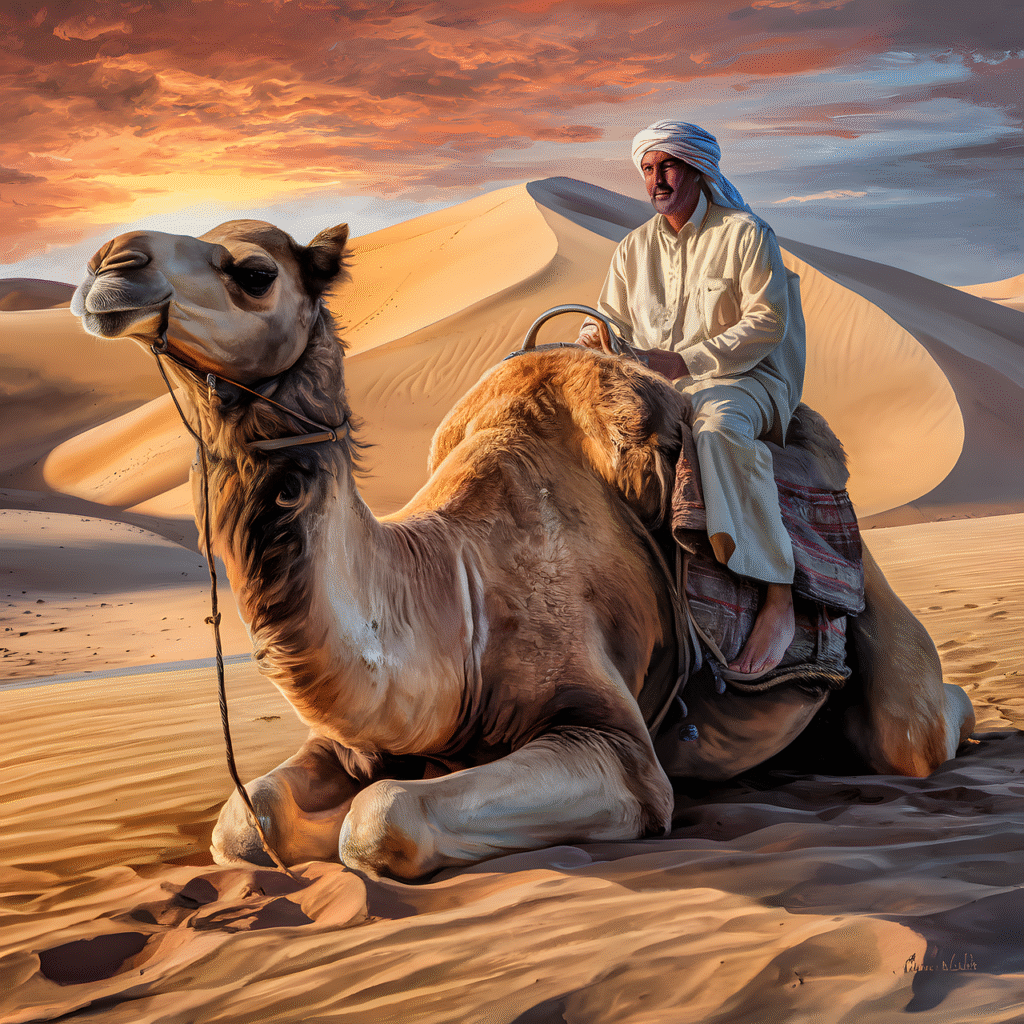
AI image generators
Some of the most popular and influential AI image generators
1. Midjourney
Best For: Highly artistic, cinematic, and professional-grade results.
Key Characteristics:
It’s known for producing aesthetically pleasing, often stylized, and dramatic images right out of the box, even with simple prompts.It mostly operates through a dedicated Discord server, though web access is becoming increasingly common; it’s a very singular experience and community-oriented.
It is often cited as the leader in creating the most visually striking and realistic “art” images.
2. DALL-E (OpenAI)
Best for: Excellent adherence to prompts and seamlessly integrates with other tools such as ChatGPT.
Key Characteristics:
Built by OpenAI, creators of ChatGPT. Its latest version, DALL-E 3, is excellent in understanding long, complex, and detailed prompts and translates these most accurately into images. This has better capabilities for generating accurate text and logos within images, which tends to be a weakness for many other models.
It is widely available through ChatGPT Plus and through Microsoft Copilot, which uses DALL-E 3 to create its images.
3. Stable Diffusion / Stability AI
Best For: Open-source flexibility, customization, and community models.
Key Characteristics:
Unlike the others, the core Stable Diffusion is open source. That means that developers and artists can download the model, customize it, and run it locally or by using specialized web interfaces like DreamStudio or Leonardo AI.It represents the largest ecosystem of “checkpoints” and “LoRAs” (fine-tuned models) developed by the community for highly specific styles-for example, specific anime, oil painting, or 3D rendering styles.
Its most powerful base model, Stable Diffusion XL, or SDXL for short, features high-quality outputs and forms the backbone for many other platforms.
4. Adobe Firefly
Best For: Commercial use, including integration into professional design workflows, such as those using Photoshop and Illustrator.
Key Characteristics:
Firefly is trained mainly on licensed and public domain content from Adobe Stock, which will help alleviate many of the copyright concerns of professionals.It was designed to work in harmony with Adobe’s Creative Cloud suite of programs, complete with features like Generative Fill for adding/removing objects from existing images and Generative Recolor for vector graphics.
It offers a high degree of control and is, therefore, the favorite of designers and marketers.
5. Leonardo AI
Best For: Digital artists who value versatility, ease of use, and an extensive model variety.
Key Characteristics:
It provides a very user-friendly interface for easy image generation, which is great for beginners.It allows users to choose between a wide range of fine-tuned models-most of them based on Stable Diffusion-to achieve a wide range of artistic looks, from game assets to hyper-realistic portraits.
It also includes 3D texture creation features, repeating pattern generation, and image-to-image transformations.
6. Nano Banana (Google Gemini’s Image Model)
Best For: Fast editing, quick idea visualizations, and modifications within the chat itself.
Key Characteristics:
This provides the image generation feature across Google Gemini models, such as Gemini 2.5 Flash; in other words, this provides a fast and very responsive experience.It excels at on-the-fly image editing, whereby a user might upload or generate an image and then ask the chatbot to quickly change the background, add a hat, or alter the style with simple text instructions.NANO BANANA pro is by far the best image generator creating realistic high quality designs and picture in second.
These tools are often locked in a cycle of rapid improvement, so the “best” choice can depend on whether your priority is artistic quality (Midjourney), accuracy (DALL-E), professional safety (Firefly), or creative control (Stable Diffusion/Leonardo AI).
Ethical and Societal Impact
While offering immense creative and commercial potential, the rise of AI-generated images brings significant challenges:
Intellectual property and copyright : Major concern pertaining to intellectual property and copyright has been over the large, often unaudited, datasets used in training. This has led to debates and lawsuits over whether the resulting art infringes on the copyright of the original human-created works it was trained on.
Deepfakes and Misinformation: The competency to create photorealistic images of people or events that never took place has fostered the spread of misinformation and the bringing about of malicious deepfakes-manipulated images, audio, or video-for fraud, harassment, or political disruption-leading to a breakdown in trust about the authenticity of digital media.
Biases and Hallucinations: Off-the-shelf image generators may reflect biases in the training data and produce imbalanced or stereotypical presentations. They are also susceptible to hallucinations where logically inconsistent artifacts, such as hands with additional fingers or incomprehensible text, may be created by the model.
It is majorly asked that Are ai images really harmful and if we give our photos to ai generator , will it use that further ?
It is a critical question regarding privacy and the usage of data. The answer depends fully on the AI tool you are using and its terms of service.
Used for Training (The “Yes” Scenario)
That being said, some companies do reserve the right to use user inputs, including uploaded images, to improve their AI models over time.
How it works: Your image is broken down into data points, or patterns, colors, and styles, and integrated into a dataset in order to make the model even better at recognizing these features in the future. That doesn’t mean that AI will remember and copy your exact picture; it learns from its style and content.
Key Example: By default, OpenAI (DALL-E/ChatGPT) may use the content you provide for training. Usually, they do offer ways a user can opt out of such data usage through their privacy settings or by using business/enterprise versions of their tools.
Risk: If you upload personal or sensitive photos and do not opt out, that data could be used in training the next version of their AI.
Used Only for Your Request (“No” Scenario)
Many platforms use the image for a very brief time to fulfill your request only, be it image-to-image modification, style transfer, inpainting.
How it works: The model processes the image to complete what the user wants it to do and then ideally discards or deletes the image and direct data derived from it after a brief period. They are not added to the permanent, long-term training set of the public model.
Key Example: Companies like Adobe Firefly, among a few others, focus on professional or commercial use and are more circumspect about their training data sources-for example, training only on licensed or public domain content-to put customers’ minds at rest regarding copyright concerns
There are three main ways an AI tool might handle a picture you upload:
Human Review and Storage
Even if the image isn’t used for general training, many companies store your images and logs of your interactions for a time in order to:
Safety and Moderation: to check against violations of their content policy, such as illegal or prohibited imagery.
Debugging: To see why the model failed or produced a poor result.
Metadata Risk: Photos often contain hidden metadata such as location, time, and device; this is extra personal data the company may retain.
What You Should Do
To preserve your privacy and intellectual property, you should always:
TOS/Privacy Policy: The only definite source of truth for any specific tool would be reading its terms of service and privacy policy. Looking for clauses around user-submitted content or model training.
Opt-out: First, check the platform’s settings or FAQs for any available options to opt out or prevent it from using your data for future training.
Be Careful with Personal Photos: Refrain from posting sensitive or identifiable personal pictures on any public AI tool unless you are sure about its privacy guarantees.
How to Mitigate Harm
AI-generated images are not inherently malicious, but their capability demands responsibility. Mitigation of risks requires:
Media Literacy: Providing the public with knowledge on how to recognize a deepfake or question the validity of digital media.
Regulation and Legislation: instituting clear legislation to prosecute malicious use of deepfakes, particularly non-consensual content, and setting the rules on data use.
Tool Safety: AI companies should also continue to implement strong safeguards against generating illegal, hateful, or non-consensual content
In sum, AI-generated images are a profound technological leap, democratizing the creation of complex visuals and opening new frontiers of creativity and productivity, while also forcing a worldwide discussion on the ethics, legal frameworks, and societal implications of easily manufacturable digital reality.The field of AI image generation is quite competitive and is continuously in development, but a number of major players stand out either for their quality, speed, or for unique features.