

Decentralized computing is a form of computing where processing, control and storage is done at so many independent nodes (users) that no one user controls all aspects of the resources in their computing environment.
Throughout most of humanity’s time on this planet, its power has operated on a gravitational basis – power is always getting more concentrated. Initially, we gave thousands of users access to computing through mainframes located in a single room. Then, we moved to client-server architectures where data centers could be as tall as skyscrapers.
Origins and prologues
The concept predates internet technology by over two decades. The ARPANET, the predecessor of today’s world-wide Web, was architected with the intention that it should be resilient to node failures; this insight from the Cold War era was based on the belief that resilience is achieved through redundancy . The cultural moment for peer-to-peer networking occurred with Napster in 1999 and BitTorrent shortly thereafter; this demonstrated how millions of average users—their shared bandwidths and storage—could work together to produce greater collective output than one distributed server. These technologies provided new ways to relate to the infrastructure we use.
The foundation for this new way of relating to our infrastructure could be said to have emerged in 2008 with the release of the Bitcoin white paper by Satoshi Nakamoto. Here was a distributed system for transferring value from one individual (who may never have met) directly to another without using a bank, clearinghouse, or other intermediaries.
Application
Today the majority of the world’s economies depend on digital infrastructure hosted by a small number of corporations (such as Amazon, Google, Microsoft) that together make up the bulk of the world’s digital infrastructure. From this perspective, it has been reasonable to believe that centralization was the ultimate conclusion of an efficient solution to computing’s power problem, but there has been a countervailing force growing for decades that is attempting to invalidate this belief at its core.
Architecture and Resilience
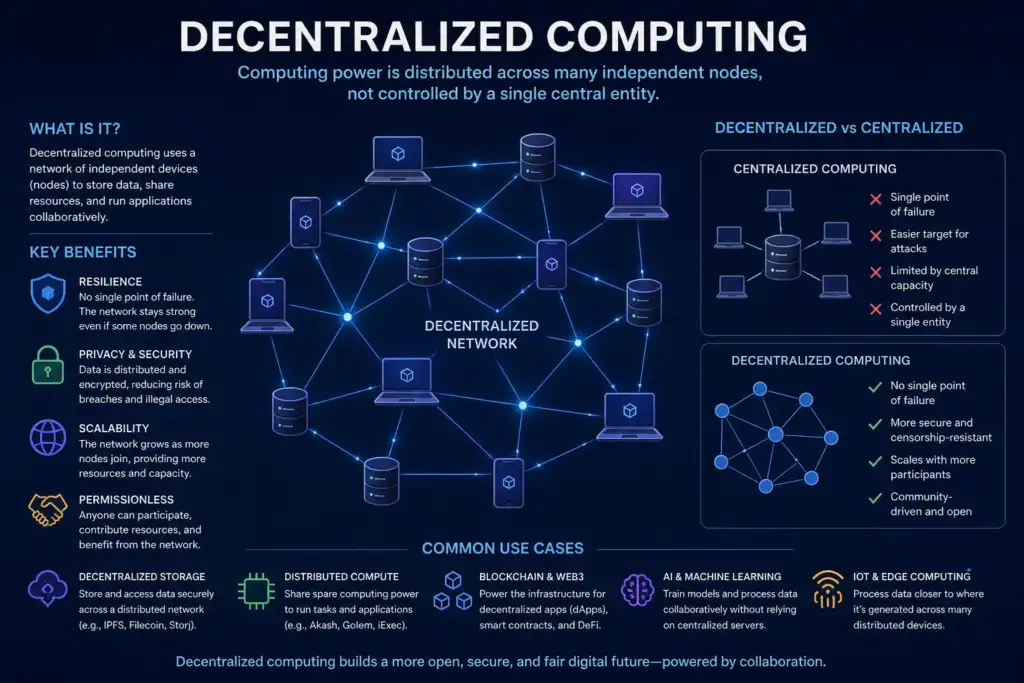
Decentralized computing provides a fundamentally different architecture for computing with respect to the machines used to create it but also with respect to trust, ownership and control. Fundamentally, decentralized computing represents the creation of systems where all processing, storage and decision-making can be distributed across numerous nodes, rather than being concentrated at one central site.
An example of this is, No one organization owns the whole system or network There is no single point of failure within the system or network—thus, if a node failed, it will not result in losing the whole system or network. The network itself is the computer—a phrase coined by Sun Microsystems some 25 years ago, which has taken on greater significance with every passing decade.
Many of the cryptographic technologies used in Bitcoin had existed prior to its creation ,however, the novel aspect of Bitcoin was the application of economic incentives to cryptographic proof. Miners who contribute to the validation of transactions within the Bitcoin network are rewarded for their participation, therefore, dishonesty becomes much more costly than cooperation. Thus, trust, which was previously a social construct, is now a mathematical construct.
IPFS
InterPlanetary File System (IPFS), which creates a way to access information using a decentralized version of the way the Internet uses the HTTP protocol. Instead of looking for content based on its location (as would happen through an HTTP request), you would locate content based on its digital fingerprint (or hash). Therefore, a file that exists on the IPFS cannot be removed by deleting a server since it can exist as long as a node of the IPFS has a copy of it cached. This function is important for archives, journalists facing censorship, and long-lasting digital preservation.
Decentralized Finance (DeFi)
Decentralized Finance (DeFi) has also created functioning lending, borrowing, trading and derivative markets based on public blockchains, thus facilitating hundreds of billions of transactions without the reliance on banks, brokers or clearinghouses. While many are experiencing the loss of money, from ‘smart contracts’ failing, the success is the establishment of international financial infrastructure that is accessible to everyone, verifiable by anyone and not controlled by anyone.
Decentralized Identity Protocols
Decentralized Identity Protocols are already being developed through various W3C-based Verifiable Credentials and self-sovereign identity (SSI) protocols; building protocols for identity verification without dependency on a password-based account owned by a corporation. With these solutions, the user retains ownership of their own identity credentials and are only required to provide access to only that data necessary to enable a third party access to data regarding that user. With people increasingly required to possess a digital identity in lieu of their physical social identity, these identity verification solutions represent a fundamental freedom rather than just a user function for convenience.
Decentralized Cloud & Edge Computing
The decentralization of blockchain has begun to change traditional methods of computing.
- Edge computing looks toward a purposeful disaggregation of the cloud wherein all data will no longer be routed to centralized data centres but rather processed closer to where they are generated (factories, hospitals, vehicles, and phones). This reduces latency, preserves bandwidth, and alleviates the worry about sending sensitive data across the globe for processing by strangers.
- Projects such as Filecoin and the Interplanetary File System (IPFS) are looking to decentralise storage by breaking files into smaller pieces, encrypting/reducing those pieces into hashes, and distributing them across a global network of peers. This means that you can request a file by providing the hash of that file and the network will locate whoever has it. Another philosophical implication of this is that once the data has been stored, it would be preserved forever and not subject to an individual actor’s willingness to continue to operate a server.
Blockchain Technology and Its Uses
Blockchain is arguably the most widely discussed decentralized computing system however, there are many examples of decentralization that do not use the blockchain as their underlying technology. The reason is that it is an extraordinarily elegant solution to the problem of keeping records in a decentralized manner , by bundling transactions into blocks and linking each successive block cryptographically to get them all to form a single chain, which is then replicated identically on many thousands of independent nodes (as an essential example of this, see the new cryptocurrency, Bitcoin). Therefore, if someone were to attempt to change a previous transaction, then they would need to recompute every subsequent block in the chain and do so with sufficient speed to stay ahead of the rest of the network. Although this is not impossible, it is prohibitively expensive to do so.
More recently, the Ethereum blockchain has built on top of the original concept of the blockchain by allowing arbitrary code (known as “smart contracts”) to be executed against the blockchain. Smart contracts are programs that execute exactly as stated and are enforced by the blockchain/network and may not be changed unilaterally by anyone. As a result, smart contracts have opened up an entirely new way of providing financial services without the involvement of traditional financial institutions, such as banks, through the use of self-executing protocols.
Advantages
Decentralized computing is based on the ideas of resilience and eliminating gatekeepers.
- With decentralized systems, there isn’t just one place where something can failwhen one node goes offline, others take over the workload.
- .They also don’t have a singular method of censorship; when one nation-state blocks access to the network, traffic can route around it. Also, they don’t have a single point of capture, no regulator, acquirer, or CEO controls the rules of a sufficiently distributed protocol without consent from all parties.
- Decentralization also addresses the monopoly-like dynamics of the existing web. When a platform hosts and controls rules regarding content, it accumulates an incredible amount of power that lacks a comparable democratic check.
Issues and Complications with Decentralized Computing
Decentralized Computing is subject to a similar critical review as that presented here. Distributing an application of 10,000 nodes incurs a cost compared with maintaining an accurate, single-point database.Moreover, scaling up any form of decentralized system to manage a volume of transactions similar to Visa or a level of data storage equivalent to that of Netflix remains an engineering challenge today.
Governance in ostensibly decentralized systems often rests with a relatively few people in a small technical elite. Finally, while disintermediation was anticipated through the usage of decentralized systems, we have found that in practice, re-intermediation is occurring through new institutional forms in circumstances where the original power dynamics are being continued.
The Deepest Argument
Decentralized computing does not claim to replace every institution,it does not provide governance for cities, military support, or response to pandemics. Rather it can produce systems where the rules are open and verifiable where transactions can be independently confirmed through audit, and where the continued functioning of the system does not depend on faith in a human being. In areas where institutional trust has demonstrated its greatest failure to provide value, decentralized approaches present an exciting possibility, because they create mathematically verifiable properties rather than relying on a contract.
The most successful decentralized systems
The most successful decentralized systems e.g., the core protocols that comprise the Internet, the Domain Name System (DNS) and the Border Gateway Protocol (BGP) , have done so not by erasing human governance from the operational, but rather, by embedding particular value systems (openness, trust and operational agreement) into the technical infrastructure that underlies these systems, and then creating institutions to govern that infrastructure.
Conclusion
In conclusion, decentralized computing infrastructures – from blockchain nodes to IPFS peers to mesh networks – represent the physical foundation of an alternative mode of social organization. These infrastructures embody the belief that coordination can occur without a hierarchical structure, that trust can be objectively recorded instead of relying upon subjectivity, and the digital infrastructure upon which we conduct our daily lives does not have to be owned by those who profit from controlling it.






2 Comments
Ayan aslam
June 3, 2026Plz matric tech subjects class 10
Health science tech
Biology tech
Physics tech
Chemistry tech
Sultan Tutor
June 6, 2026Download all your Tech Books from the Official Link https://pectaa.edu.pk/curriculum-compliance/