

Introduction
In a computer system, the brain is known as a processor or a Central Processing Unit (CPU). The processor is responsible for executing instructions, doing math calculations, and managing the flow of information in a computer. Processors are one of the greatest technological accomplishments in human history. They have transformed from simple mechanical concepts to containing a billion transistors in a single chip. This subject will examine the emergence of processors, ideas behind the development of processors, how a processor works, companies involved in processor development, the history of processor development, processor development in the present era, and what to expect in the future.
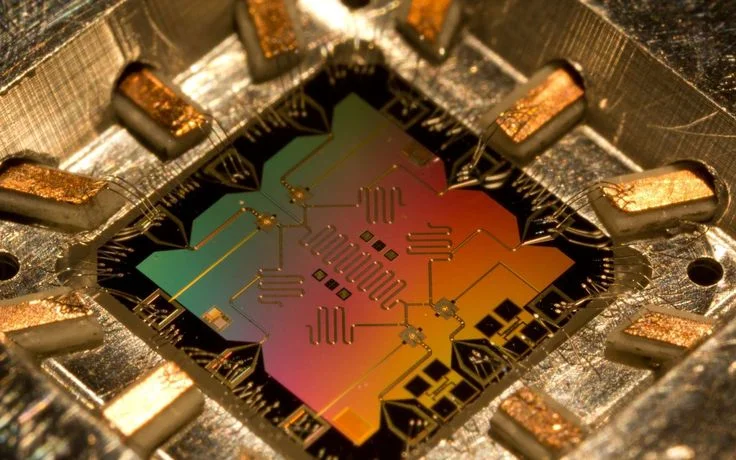
Early Concepts and the Birth of Processors
The idea of information processing has been around for many centuries before the advent of computersThe term “processor” has been used with regard to computers at least from the early 1950’s. The earliest computers employed large arrays of vacuum tubes. Early computers were immense, costly, and power hungry, thus only big institutions could afford to buy one. This is one of the first processors in the modern sense – the Ferranti Mark 1 – described because it was the first commercially available general-purpose computer that could store programs..
Early Electronic Computing
- 1940s Vacuum Tube Computers: Computers such as ENIAC used thousands of vacuum tubes to execute calculations. These computers, although not microprocessors, formed a precursor to computation via electronics.
- They were huge, power-consuming, unreliable, yet the concept ushered in the notion of having a centralized unit which performs logic/arithmetic calculations.
Emergence of the Modern Processor
From its discovery of silicon in 1823, the very basis for these processors, to today’s processors, the first electrical logic circuits were patented by Nikola Tesla in 1903.
The real history of the processor dates from the development of the transistor.The invention of the transistor brought about a rapid innovation in the computer industry. Transistors enabled computer processors to be denser and more power efficient, reducing the size of computers from rooms to something that could fit on a desk. Processors began to increase in processing power by a factor of two every year as the transistors shrunk in size and more could be integrated in a single computer-an observation known as Moore’s law. The first transistors used in computing were millimeters across; now modern transistors can be produced at less than 5nm
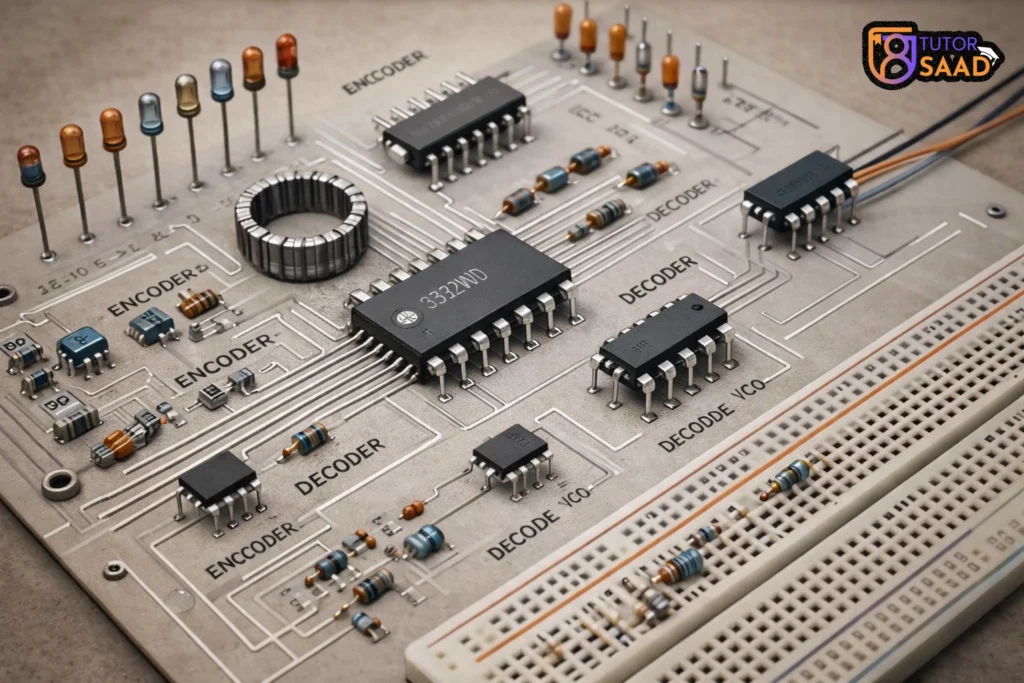
Transistors and Integrated Circuits
- 1947: The transistor is discovered at Bell Laboratories, replacing the large vacuum tubes used in electronic devices. Bell Labs invented the first transistor. In 1958, the first working integrated circuit was developed.
- Just two years later, IBM developed the first automatic mass-production facility. It was then in 1965 that Moore’s Law about integrated circuits was observed, followed by the founding of Advanced Micro Devices or AMD in 1969.
- They started the quest of making processors faster and cheaper. The Atari, Nintendo, Apple II, and Commodore video game consoles started to implement the use of the processor MOS Technology 6502 processor starting in 1975.
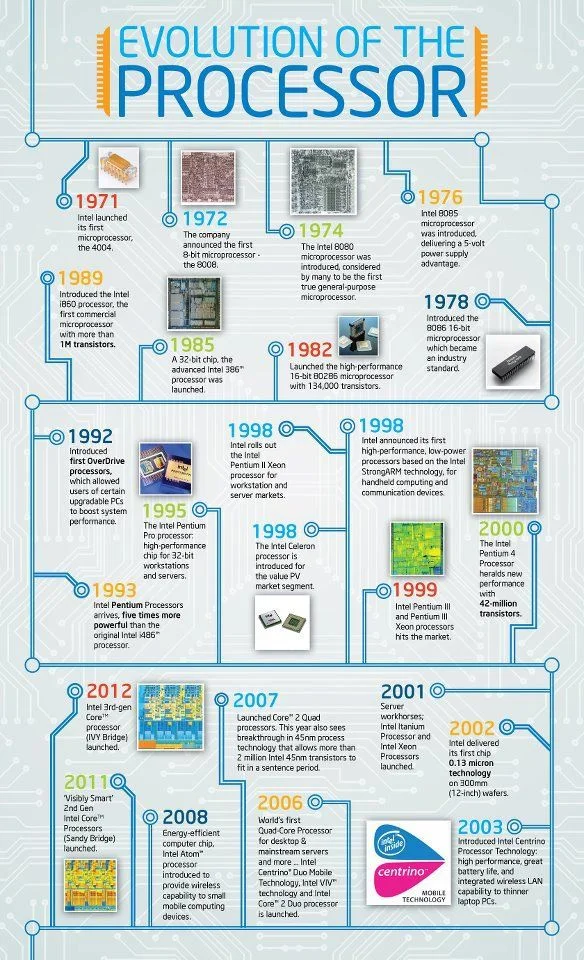
- Processors continued their development from the 1970s until today. This was led by the giants Intel and AMD. Intel broke waves when they introduced to the market the world’s first microprocessor – the Intel 4004 – in 1971. In 1974, Motorola also came up with its first processor, the same year that Intel was quick to release an enhanced microprocessor chip, the 8080, which then became the standard of the computer industry.
- 1958–1959: Integrated circuits were invented, and it became possible to combine a number of transistors on a single chip.
The First Microprocessor
- 1971 – Intel 4004: It was the world’s first microprocessor. It had 2,300 transistors and the ability to perform simple operations.Intel 4004 was the first discrete processor that was similar to modern devices. The 4004 packed all of the logic circuits required by a computer onto one processor. Sold as a single discrete chip for general use, it brought computing power to consumer devices such as digital calculators and pinball machines.
- This was the transition period to much smaller computers, which were programmable.
How a Processor Works?
Processors organize information, carry out input instructions, and determine a computer’s proficiency in speed. This applies to software engineers because this determines the speed at which they can work; this also allows them to be able to troubleshoot and debug issues in software. The better the processing power, the faster a software engineer is able to process their code.
A processor works by adopting a never-ending cycle known as the Fetch-Decode-Execute Cycle.
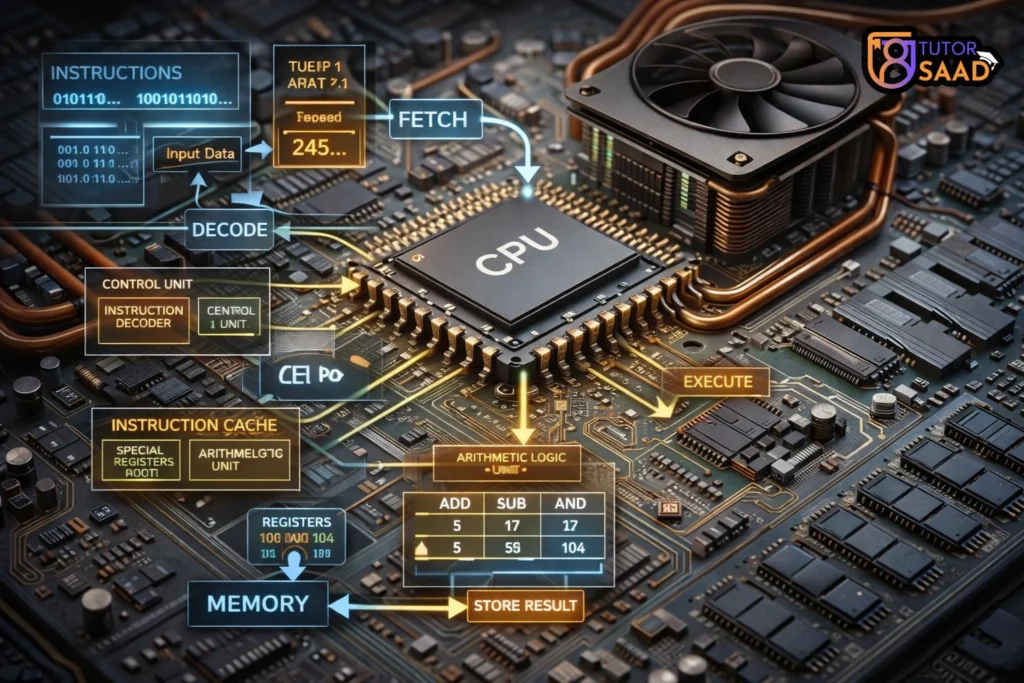
Main Components of a Processor
- Control Unit (CU): Manages the flow of data and instructions.
- Arithmetic-Logic Unit (ALU): The ALU is used to perform arithmetic
- Registers: These are small, high-speed storage locations within the CPU.
- Cache Memory: It holds data that is most likely to be used.
- Clock: Synchronizes operations by producing a timing signal.
Elementary Working Cycle
- Fetch: The CPU fetches an instruction from the memory.
- Decoded: This entails the process of deciphering
- Execute: It involves the execution of the operation, possibly a computation or data transfer.
- Store: The results are recorded back in the memory or registers.
Such a cycle is repeated billions of times every second in modern computers.
Processor Speed
The speed of a processor is determined by the number of hertz (Hz). Normally, the higher the clock speed, the more instructions a processor can execute per second. However, the total performance depends on other issues, such as the architecture of the processor, the number of cores, and the size of the cache. Modern processors usually run at a clock speed of between 1 GHz and 5 GHz.
Historical Development of Processors
1970s-1980
- Introduction of 8-bit and 16-bit processors.
- Appeared in the earliest personal computers and gaming systems.
- Primarily the focus was on the processor speed.
1990s: The Performance
- The use of 32-bit processors became the
- Pipelining, superscalar execution, and cache hierarchies.
- Personal computers increased in power and availability.
2000s: Multi-Core
- Technological limitations softened the effectiveness of improved clock speeds.
- The industry brought out manufactures of multi-core processors.
- Increase emphasis on energy efficiency and heat management.
2010s: Specialized
- The role of Graphics Processing Units (GPUs) in parallel processing.
- Creation of mobile processors (SoCs) that include the CPU, GPU, and other components.
- More attention to performance per watt.

Processor Cores
Along with clock speed, processors house more than one core-these are independent units of processing on a single chip. Each core can run its own stream of instructions independently. This provides parallelization of work and therefore better multitasking and performance compared to single-core processors, especially for applications designed to use multiple cores. Most modern processors have a range of 2-8 cores. However, high-performance and professional processors, especially those that could perform activities such as gaming and manipulation in video editing or even 3D rendering, might have even up to 16 cores depending on their intended use.
Types of Computer Processors
The Processor types can be based on functionality or role, architecture and design, core numbers, or performance levels. Each processor type has been tailored for particular types of computing. These range from general-purpose computing through specialized computation. Most contemporary processors have multiple cores for carrying out parallel processing.
Classification by Architecture / Design
There exist two types of processors. These types include x86/x64 and ARM. These processors have the basic function of executing instructions. They vary in their design, performance, efficiency, and capabilities.
x86/x64 processors
The x86/x64 processors are commonly used in desktop computers, laptops, and servers. They are meant to support heavy loads and handle complicated applications. The x86/x64 processors can be replaced in desktop computers, whereas in most laptops, they are fixed into the motherboard. Examples are the Intel Core i3, i5, i7, and i9 processors and the AMD Ryzen processors.
ARM Processors
ARM is short for “Advanced RISC Machine” processors, which utilize a RISC (Reduced Instruction Set Computing) system, which is very energy-efficient. These processors were originally designed byApple Corporation, which later spun off this subsidiary company: ARM Holdings.
Today, ARM processors are also being increasingly utilized in laptops and server applications due to a marked improvement in performance. Notably among these are Apple’s M-series processors, designed to provide a high performance and efficient energy consumption.
RISC (Reduced Instruction Set Computer)
RISC architecture mainly concentrates on the idea that a CPU should have simple and fast instructions so that processors can perform instructions efficiently. ARM processors follow RISC architecture and are suitable for mobile systems.
CISC (Complex Instruction Set Computer)
The architecture for CISC is complex. It can do several instructions in one single instruction. The x86 architecture is based on CISC. The reason is because this architecture is quite flexible and has high performance.
System on a Chip (SoC)
A System on a Chip is an integration of various components like the processor, graphics processing unit, memory controller, among others, onto one single chip. This technology is applied mainly in smartphones and tablet PCs. They mainly help in power efficiency
Classification of Processor (By Function / Role)
Central Processing Unit (CPU)
The Central Processing Unit is a major processor with general-purpose instructions to run apps, handle system operations, and process user inputs. It also has arithmetic, logical, and control operations. Examples are Intel Core and AMD Ryzen. These are widely seen in desktop and laptops.
Graphics Processing Unit (GPU)
The Graphics Processing Unit is a processor that was built to handle the job of high-end graphics rendering and highly parallel computing. This processor has the ability to process a huge amount of data in parallel. This processor has applications in gaming, video rendering, AI, or ML. These processors are available in the markets by brands named NVIDIA and AMD.
Digital Signal Processor (DSP)
A Digital Signal Processor specializes in signal processing work like audio processing, video compression, and telecommunications. Digital Signal Processors can also be found in multimedia systems, smartphones, and communications systems.
Microcontroller / Embedded Processor
Embedded processors are made to perform a specific function as part of a electronic product. Car systems, home appliances, and industrial devices use these processors to cater to their tasks accordingly. These processors are made to perform well where reliability, power efficiency, and real-time execution are a must.
Neural Processing Unit (NPU)
Neural Processing Units are special processors that are tailored for artificial intelligence and machine learning tasks. They help to accelerate tasks of image recognition, speech recognition, as well as calculating tasks on a neural network, and they are becoming an integral part of modern mobile technology.
Famous Processor Manufacturers
Intel
- Inventor of the microprocessor.
- Known for x86 architecture.
- The PC processor market leader for several decades.
AMD (Advanced Micro Devices)
- Principal rival of Intel.
- Bringers of innovations in multi-core architecture and High-Performance Computing.
ARM
ARM
- Developing energy-efficient processor designs.
- Leads the market in smartphones, tablets, and embedded systems.
Apple
- Designed proprietary ARM processors (M-series).
- Emphasizes close hardware and software integration.
NVIDIA
- Market Leader: GPU and AI Processor.
- It is an important part in machine learning and a data center.
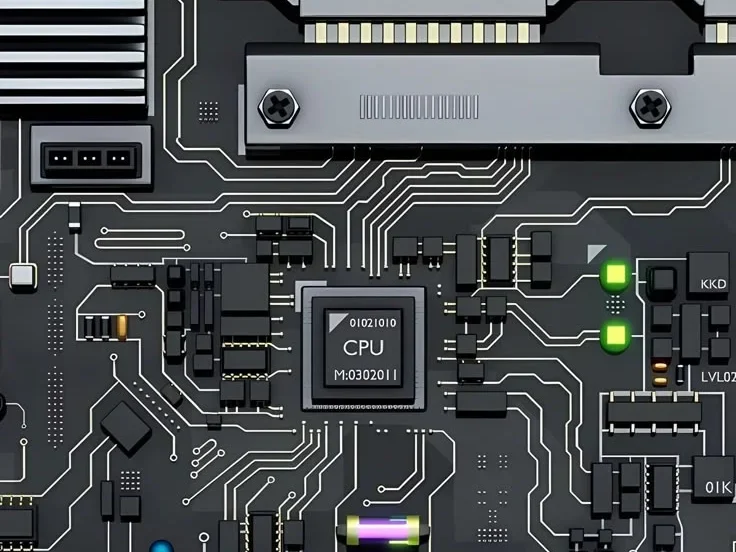
Advancements in Processor Technology
Miniaturization
- The size of transistors decreased from micrometers to nanometers.
- Billions of transistors are packed into a single chip.
Parallelism
- Multi-core processors. Many-core processors.
- Simultaneous multi-threading enhances efficiency.
Acceleration of AI and Machine Learning
- Specialized cores and NPUs for AI. Employed in speech processing, image processing, and autonomous robots.
- Energy Efficiency
- Concentrate on low-power designs for cell phones and data centers.
- Power management and control. — Future of Processors # Beyond Silicon Research into newer materials like graphene and carbon nanotubes.
- Capability of surmounting the physical limitations of silicon.
- Quantum Processors : Replace binary bits with quantum bits (qubits). Able to solve some problems faster by an exponential factor.
- Neuromorphic Computing Neural processors modeled on the human brain. * For optimized processing by the AI and recognition engines.
- 3D Chip Design Stacking chips vertically to enhance performance and lower latency. ### Ubiquitous Computing * Processors found in ubiquitous objects (IoT).
- Smart cities, medical devices, and autonomous vehicles. — .






2 Comments
Ayan aslam
June 3, 2026Plz matric tech subjects class 10
Health science tech
Biology tech
Physics tech
Chemistry tech
Sultan Tutor
June 6, 2026Download all your Tech Books from the Official Link https://pectaa.edu.pk/curriculum-compliance/