

Virtual reality (VR) and augmented reality (AR) have exciting potential in the future of gaming, marketing, e-commerce, education, and many other fields. Extended reality (XR) gives us a new view of the world, creating a more immersive and interactive experience where users can do almost anything interact with friends and family, learn, work, shop, create, game, and enjoy entirely new experiences. XR encompasses augmented reality (AR), virtual reality (VR), and mixed reality (MR). While all three ‘realities’ share features, each has different purposes.
Augmented Reality (AR)
Almost any person with a smartphone can get access to augmented reality, making it more efficient than VR as a branding and gaming tool. AR morphs the mundane, physical world into a colorful, visual one by projecting virtual pictures and characters through a phone’s camera or video viewer. Augmented reality is merely adding to the user’s real-life experience.
Virtual Reality (VR)
Virtual reality takes these same components to another level by producing an entirely computer-generated simulation of an alternate world. These immersive simulations can create almost any visual or place imaginable for the player using special equipment such as computers, sensors, headsets, and gloves.
How AR works:
Augmented reality works by overlaying digital objects, information, or other sensory elements on top of the physical world to provide users with a beneficial, informative, or entertaining experience depending on the application. AR can be used on a range of devices, including smartphones or tablets, headsets or glasses.
Take a look at some specific augmented reality examples where companies have used the technology innovatively and effectively.
- Pokemon Go.
- Adidas: Trying on shoes.
- Netflix and Stranger Things
- Ikea: Furniture arrangements
- Home Depot: Color options

How VR works:
Virtual reality (VR) works by simulating a realistic 3D environment through a combination of hardware and software.
The basis of VR technology is an end-to-end mechanism that replaces the natural environment with a deceptively real-looking simulation.
This simulation is strongly oriented to the real world. In order to adapt the digital world to the real world as best as possible, modern AI algorithms are usually used. These have the task of projecting new and familiar elements onto a mathematically defined surface. The result is a virtual world that looks deceptively real to users.
The hardware typically includes a headset or display, motion controllers, and sensors that track the user’s movements and gestures in real-time. The software involves creating a digital environment using computer-generated graphics, audio, and other sensory inputs to simulate a fully immersive experience.
Take a look at some specific virtual reality examples where companies have used the technology innovatively and effectively.
- Resident Evil 4 VR (Gaming)
- Osso VR (Medical)
- Google Expeditions (Education)
- Matterport (Architect)
- IKEA VR Home Experience (Retail)
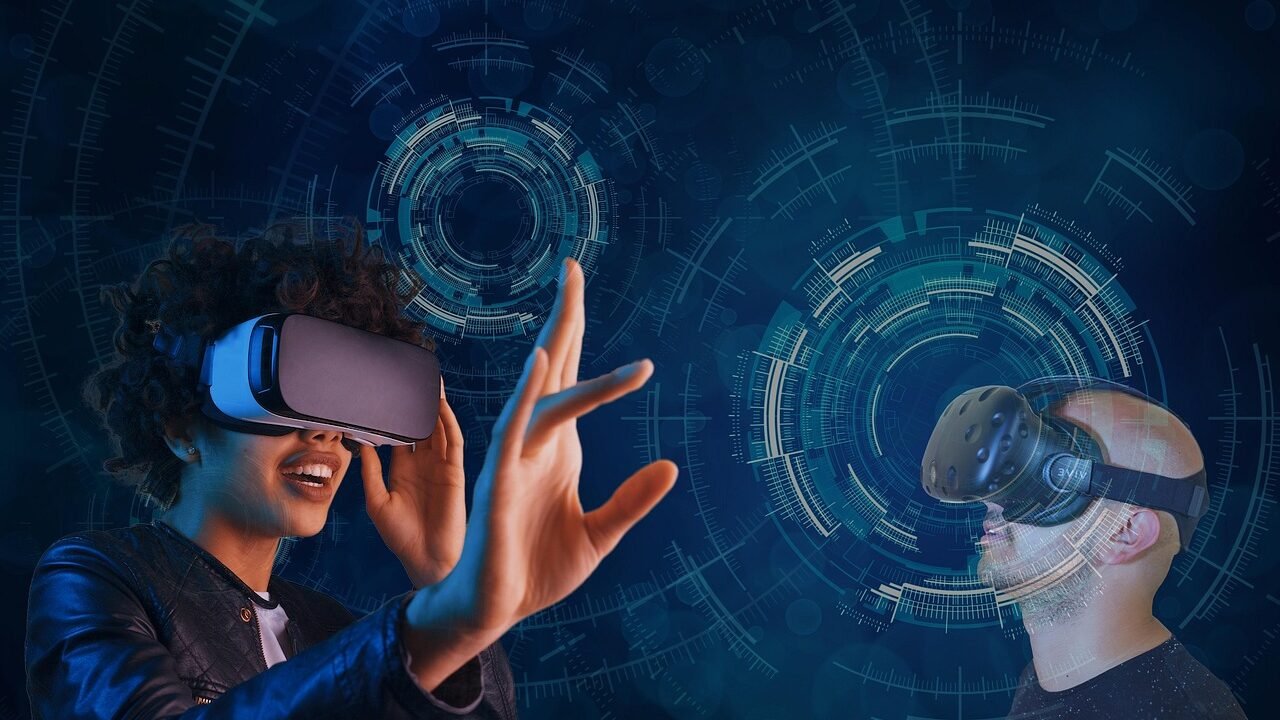
Which is the best:
The distinctions between VR and AR come down to the devices they require and the experience itself:
- AR uses a real-world setting while VR is completely virtual
- AR users can control their presence in the real world; VR users are controlled by the system
- VR requires a headset device, but AR can be accessed with a smartphone
- AR enhances both the virtual and real world while VR only enhances a fictional reality
Future of AR & VR:
Improvements in hardware and software, as well as the introduction of novel uses, have led to exciting developments in the field of augmented and virtual reality in recent years. The following are some of the emerging trends in AR/VR technology:
- Mixed Reality: a hybrid experience that combines virtual and real-world elements to create immersion and interactivity.
- Haptic Feedback: Users will have the sensation of physically touching and interacting with virtual objects thanks to recent developments in haptic feedback technology.
- Eye-Tracking: Eye-tracking technology can enhance user experience by allowing users to control devices and applications with their eyes.
- 5G Networks: The rollout of 5G networks will enable faster data transfer speeds and low latency, which is crucial for AR/VR applications.
- Spatial Audio: Spatial audio technology will create more immersive and realistic experiences by placing sound in a 3D environment.
More interactive and realistic AR/VR experiences will soon be possible thanks to developments in hardware and software. Artificial intelligence (AI) also plays a crucial part in improving AR/VR applications. Better object and person tracking is made possible by AI, which in turn makes for more immersive experiences.

Conclusion:
“We stand at the dawn of an exciting era marked by innovation and change, driven by VR, AR, and AI“. These technologies are redefining our ways of living, working, and interacting, opening up a universe of previously unimaginable possibilities. However, it is crucial that we enter this new era responsibly and thoughtfully, addressing ethical and social challenges and ensuring that the benefits of these technologies are accessible to all and enrich our human experience sustainably and respectfully






2 Comments
Ayan aslam
June 3, 2026Plz matric tech subjects class 10
Health science tech
Biology tech
Physics tech
Chemistry tech
Sultan Tutor
June 6, 2026Download all your Tech Books from the Official Link https://pectaa.edu.pk/curriculum-compliance/